
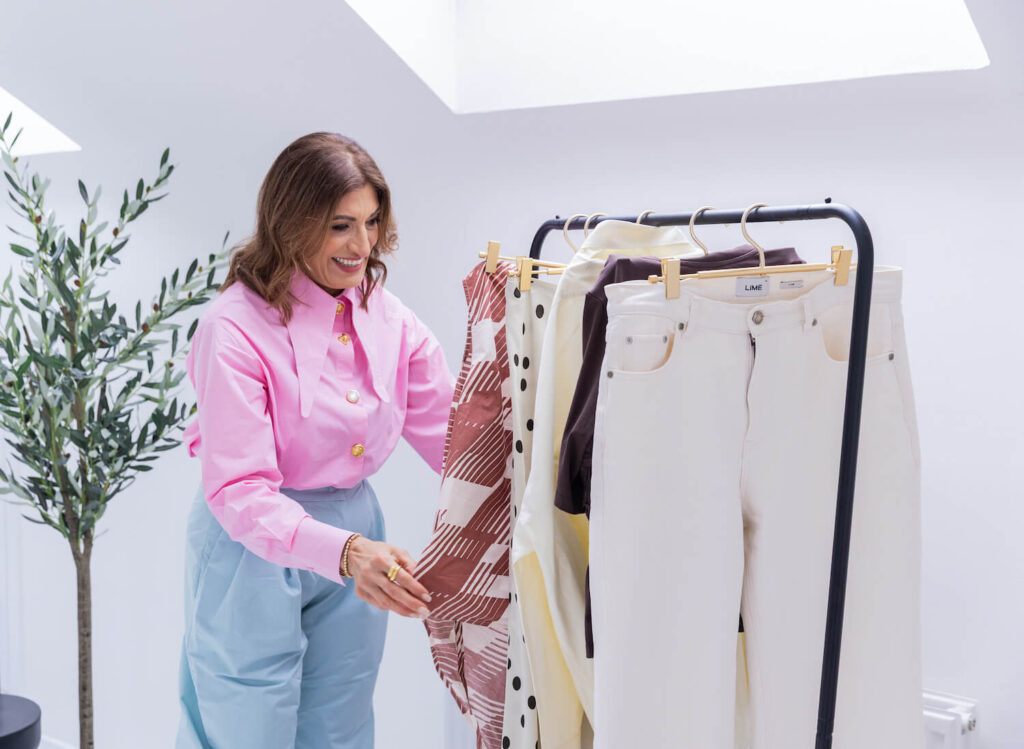
Have you ever stood in front of a wardrobe full of clothes and thought, “I have absolutely nothing to wear”?
I have heard this countless times. And what I have learned is that the problem is rarely that you need more clothes. More often, you need to edit the wardrobe you already have.
Wardrobe editing is not simply decluttering. It is the process of looking at your clothes with a more discerning eye, understanding what genuinely works for your lifestyle and personal style, identifying what is missing, and creating combinations that make getting dressed easier.
For me, a great wardrobe should do three things:
- Reflect who you are
- Support the life you actually live
- And make you feel wonderful when you wear it.
That is the philosophy behind my wardrobe editing service at Style Codes. I work with clients to sort, coordinate and rethink what they already own, so their wardrobe becomes easier to navigate and far more useful.
And no, this does not mean throwing half your wardrobe away. It means learning to see it differently.
What Is Wardrobe Editing?
Wardrobe editing is essentially a professional wardrobe reset. A professional personal stylist like myself looks at your existing clothes, shoes and accessories and help you determine:
- What genuinely suits you
- What fits your current lifestyle
- What still reflects your personality
- What can be styled in multiple ways
- What needs altering or repairing
- What should be donated, sold or passed on
- What you are missing
- What you should stop buying
- And, importantly, how to put everything together
This is very different from simply organising your wardrobe by colour or folding everything neatly. An organised wardrobe can still be a wardrobe that doesn’t work.
You can have beautiful clothes hanging perfectly in your closet and still reach for the same three outfits every week. That is where wardrobe editing becomes valuable.
Why Do We Have So Many Clothes Yet Feel We Have Nothing to Wear?
- We buy for the person we think we should be.
- We buy because something looks fantastic on somebody else.
- We buy because it is on sale.
- We buy because we are going through a particular phase.
- We buy for an imaginary lifestyle.
- We buy something beautiful without considering what it will work with.
And sometimes, we simply don’t know what actually suits us. Then our wardrobes become a collection of individual pieces rather than a cohesive personal wardrobe.
- A beautiful blouse that doesn’t work with your trousers.
- A dress you love but never have anywhere to wear.
- A pair of shoes that look wonderful but are impossible to walk in.
- Five black trousers that all serve essentially the same purpose.
- A beautiful jacket that has been sitting untouched for two years because you don’t know what to wear underneath it.
This is exactly why I don’t believe wardrobe editing is about simply asking, “Have you worn this in the last year?”
There are much better questions to ask.
How to Effectively Edit Your Wardrobe
If you want to start yourself, I recommend approaching your wardrobe in stages rather than attempting to make hundreds of decisions in one afternoon.
1. Take Everything Out
Yes, everything. Not just the clothes hanging at eye level. Look at hanging clothes, drawers, shoes, bags, accessories, occasion wear, coats and jackets, clothes stored elsewhere, and items you have forgotten about.
You cannot properly edit what you cannot see. Once everything is visible, you can start identifying patterns.
2. Create Four Categories
KEEP
These are the pieces you love, wear and feel good in. They fit your body, lifestyle and personal style.
MAYBE
These require a little more thought. Perhaps you love them but rarely wear them. Perhaps they need alterations. Perhaps you aren’t sure how to style them.
LET GO
These are pieces that no longer serve you. They may be worn out, uncomfortable, unsuitable for your current lifestyle, or simply no longer feel like you.
OCCASION / SEASONAL
Some clothes naturally have limited use. A beautiful evening gown doesn’t need to justify itself by being worn every month. The important thing is knowing why you are keeping it.
What Is the 90/90 Rule for Decluttering Clothes?
You may come across different wardrobe decluttering rules online, including the 90/90 rule. One version asks: Have I worn this in the last 90 days? Will I wear it in the next 90 days?
These kinds of rules can be useful because they force you to make a decision rather than endlessly moving clothes from one side of the wardrobe to the other.
But I would never use a formula blindly. Seasonality matters. Occasion wear matters. Your lifestyle matters.
A winter coat may not have been worn in months and still be an essential part of your wardrobe. So use these rules as decision-making tools, not absolute laws.
What Is the 10/10 Rule for Decluttering?
Another popular approach is the 10/10 rule. There are different interpretations of this method, but the underlying idea is to pause and consider whether an item has enough practical or personal value to justify keeping it.
There are many variations of these decluttering formulas online. And while I enjoy a good wardrobe rule, I believe the more important question is:
Does this piece earn its place in your wardrobe? Not because it was expensive. Not because you might wear it someday. Not because somebody gave it to you.
But because it contributes something meaningful to your wardrobe.
What Is the 70/30 Rule for a Wardrobe?
The 70/30 concept is often used to describe the balance between classic, versatile pieces and more expressive or trend-led pieces.
I actually like the thinking behind this. Your wardrobe needs a foundation. But it also needs personality.
If everything is a basic neutral, your wardrobe can become boring. If everything is statement fashion, getting dressed can become surprisingly difficult.
The exact percentage matters less to me than the principle: build a wardrobe that has both versatility and personality.
Your wardrobe should have pieces that make everything else easier, alongside pieces that make you feel distinctly you.
What Is the 3-3-3 Rule for a Wardrobe?
The 3-3-3 method is another wardrobe challenge that has become popular online. There are different interpretations, but the general idea is to work with a deliberately limited selection of clothing and create multiple outfits from it.
And this is where I think these wardrobe challenges become interesting. They demonstrate something many women don’t realise:
You probably own more outfit possibilities than you think. Sometimes the issue isn’t a lack of clothes. It’s a lack of styling ideas. Give someone three tops, three bottoms and three pairs of shoes and suddenly they start thinking creatively.
Now imagine applying that same thinking to your entire wardrobe.
What Is the 5-4-3-2-1 Wardrobe Method?
The 5-4-3-2-1 method is another popular framework designed to simplify what you pack or wear by limiting the number of pieces in different categories.
Again, I don’t believe you need to follow the numbers religiously. What I love about these methods is that they encourage intentional dressing.
Instead of asking, “What else can I buy?” you start asking, “How many different ways can I wear what I already own?” That is a much more interesting question.
Your Wardrobe Should Reflect Your Signature Style
Ultimately, wardrobe editing isn’t really about clothes. It is about clarity.
When you know your colours, silhouettes, proportions, lifestyle requirements and personal preferences, shopping becomes easier. You stop buying random things, you stop following every trend, you stop opening your wardrobe every morning and feeling overwhelmed. And you start developing something much more valuable: a signature style.
My approach to styling is always personal. My background in fashion, modelling, buying and personal styling has taught me that style isn’t a formula that can simply be copied from someone else. It has to work with the individual, their lifestyle and the way they want to present themselves.
So, Should You Edit Your Wardrobe Yourself or Hire a Stylist?
If your wardrobe is relatively simple, you may absolutely be able to do a lot of this yourself. But if you have a large wardrobe, expensive pieces, sentimental items, a busy lifestyle or simply don’t trust your own eye, this is where professional wardrobe editing can make a significant difference.
When I work with a client, I don’t simply stand there and say: “Keep this. Throw that.” We look at the wardrobe as a whole. We discover what works. We find new combinations. We identify what is missing. We rescue pieces that have been neglected. We make the wardrobe more functional. And we create a much clearer understanding of what the client should look for when shopping in the future.
That is why my wardrobe editing service is not simply a decluttering service. It is a personal styling experience designed around you, and you can start by taking our free color analysis quiz or by booking an appointment here.
